The rule of thumb
For one or two data routes a direct connection is enough. From around three systems a middleware hub pays off.
 STRUCTON
IT systems · data routes that hold
Orders into the ERP, documents to DATEV, appointments into the CRM – reliably connected.
What happens here
Every data packet passes the control ring. Checked.
With checks and logging, so nothing gets lost silently.
The red seal
We build what pays off.
After the first consultation a binding price applies. You can see the progress in your customer area at any time.
Without a proper integration, data exchange means: export, e-mail, import, hope. Off-the-shelf connectors do not know your special case.
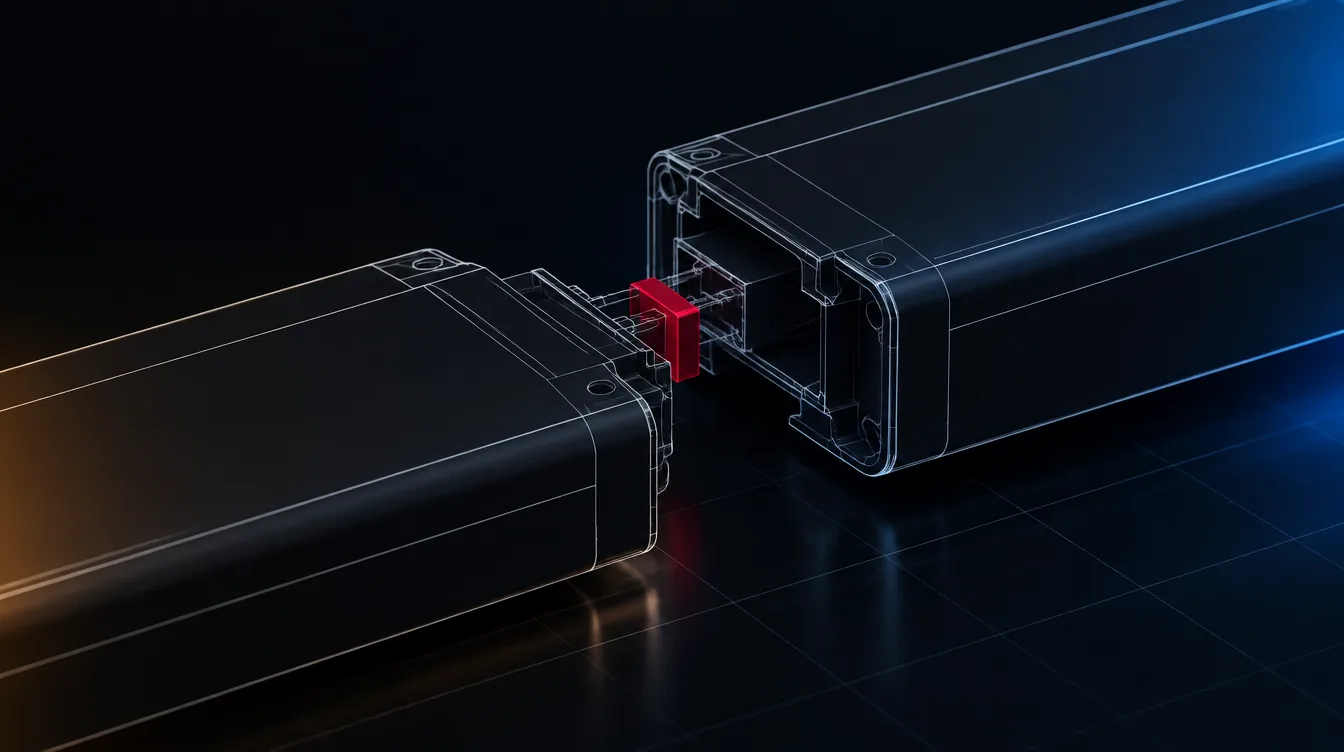
Every data packet is checked and confirmed. If something goes wrong, the integration retries and reports back.
TRANSFER LOG
09:41:02 Order #4711 received ✓
09:41:02 Fields checked (total, VAT, address) ✓
09:41:03 ERP unreachable – retry 2 in 30 s
09:41:33 Order created in the ERP ✓
09:41:33 Check: 1/1 transferred, 0 open ✓
Which data, where to, how often – and what happens if something fails.
We build and test with simulated outages.
You can see at any time what has been transferred and what is still open.
For one or two data routes a direct connection is enough. From around three systems a middleware hub pays off.
A good integration proves itself when something goes wrong. It retries, flags gaps and logs every packet.
If a provider changes its API, it only affects the connection, not your processes. Monitoring spots it before anything fails.
Then we build the data route: if both systems have an API, that is routine. If one has none, we check alternatives – automated export/import, a database connection or, in an emergency, robot-assisted transfer. Which of those carries we tell you in advance.
No – that is exactly why we build in retry logic and queues: packets that cannot be delivered stay put and are retried automatically. You can see at any time in the log what is outstanding. Losing things silently is the one error we rule out by construction.
Both are possible, and the answer is: not everything needs real time. Orders yes, statistics no. We define per data route what it needs – real time by webhook or a scheduled sync – and save complexity and cost.
Yours. The code sits in your accounts, documented and transferable. We are glad to take on maintenance by contract – but we need not: any capable developer can work on from the documentation. No dependency trap.
That happens – which is why we encapsulate the connection, monitor announcements and error rates and follow versions in a controlled way. With a maintenance contract this happens before you notice anything.
Encrypted transfer, access with the minimum necessary rights, processing preferably in the EU – and no customer data via US services without your explicit consent. The log stores metadata, not unnecessary content.
Free consultation at a fixed appointment – or a non-binding price range first.
Free consultation Request a quote Foto: Matheus Bertelli / Pexels
IT systems
CRM für den Mittelstand: Standard einführen oder selbst bauen?
Standard-CRM oder eigene Lösung? Wir rechnen die Kosten über fünf Jahre durch und zeigen, welche Rolle Datenstandort und Ihre Abläufe dabei spielen.
5 Min. · Weiterlesen →
 Foto: Jack Sparrow / Pexels
IT systems
Datenmigration ohne Datenverlust: in vier Stationen ins neue System
Der Systemwechsel steht, die Sorge bleibt: Geht dabei etwas verloren? Vier Stationen, ein Probelauf und ein Rückweg machen die Antwort überprüfbar.
5 Min. · Weiterlesen →
 Foto: panumas nikhomkhai / Pexels
Costs
Website-Wartung: Was der laufende Betrieb wirklich kostet
Nach dem Livegang fängt die Arbeit an einer Website erst an. Welche Posten im laufenden Betrieb anfallen und wie Sie sie verlässlich einplanen können.
5 Min. · Weiterlesen →
Case Study · HANSEKREDIT
First a name, today a head start.
Von der Marke bis zur eigenen Suite mit KI – Branding, Website, Ads und Automatisierung aus einer Hand.
Case Study ansehen →